

Cyber Security in the Maritime Industry
- Home
- »
- Cyber Security in the Maritime Industry
Secure System Architecture for Connected Ships
This page frames cybersecurity as a safety-critical topic in the maritime domain, describes typical threat scenarios for connected ships, and outlines technical approaches for the structured protection of systems and networks. Cybersecurity is not viewed in isolation, but rather as an integral part of a secure maritime system and network architecture – an approach that VEINLAND follows in its solutions and concepts.
Cybersecurity Is Now Part of a Ship’s Seaworthiness
The maritime industry is undergoing a profound technological transformation. Modern ships are highly networked systems in which navigation, engine control, sensor technology, communication, and management systems all rely on IP-based network technology.
At the same time, there are continuous external interfaces – for example, via satellite communication, port infrastructures, or remote maintenance access. These connections create new attack surfaces that can directly impact operational safety, availability, and liability.
Maritime cybersecurity is therefore not an optional IT topic, but an essential component of a ship’s seaworthiness. VEINLAND accordingly considers cybersecurity to be an integral part of a secure maritime system architecture.

We create resilience, transparency, and controllability.
How VEINLAND Supports Cybersecurity on Board Ships
VEINLAND is not a traditional IT security provider and not a manufacturer of endpoint or antivirus solutions. The focus is on the secure structuring, separation, and control of maritime networks.
The VEINLAND approach is based on the following core principles:
- Clear separation of safety-critical systems
- Controlled and traceable data flows
- Reduction of unnecessary network connections
- Continuous monitoring instead of flying blind
- Standards-compliant and auditable architecture
In this way, we provide the technical foundation upon which shipping companies, shipyards, and system integrators can systematically manage cyber risks.
The aim is resilience, transparency, and controllability.
Current Threat Landscape in Maritime Cybersecurity
The real threat landscape in shipping is rarely spectacular, but it is structurally significant. In practice, most cyber risks arise from:
- Insufficient network segmentation
- Lack of access control
- Inadequate monitoring
- Complex system landscapes with unclear responsibilities
Typical threat scenarios are outlined below.
If you are already familiar with these risks and want to jump directly to the solutions,
see VEINLAND’s solution approaches for maritime cybersecurity.
Common Cyber Risks on Board
Network Manipulation and Man-in-the-Middle Attacks
What does network manipulation on board mean? This term refers to redirecting, altering, or eavesdropping on data flows within an onboard network – for example, through ARP spoofing or rogue gateways.
Why is this relevant in a maritime context? Navigation and operational technology (OT) systems rely on continuous, correct data streams. Manipulated data can lead to incorrect decisions.
What happens without appropriate countermeasures? Such manipulations often go unnoticed and directly affect navigation, sensors, or machinery operations.
How does VEINLAND contribute to risk mitigation? By using structured network segmentation, defined transition points, and controlled communication paths, the attack surface is significantly reduced.
Unauthorized Devices in the Onboard Network
Why do unauthorized devices pose a risk? Maintenance laptops, personal devices, or temporary systems can gain direct network access without any oversight or control.
What are the potential consequences? Malware can be introduced, or devices may unintentionally serve as a bridge between network segments.
VEINLAND’s approach: Network access is never implicitly trusted. Critical systems are logically and physically separated, and access is strictly limited.
Lateral Movement Between IT and OT Systems
What does lateral movement mean? It refers to the ability to move within a network from one compromised system to additional systems – for example, from the office IT network to navigation or machinery systems.
Why is this critical? A single incident can therefore affect multiple safety-critical systems.
VEINLAND’s approach: Zone concepts and controlled transitions prevent direct connections between IT and OT areas.
Lack of Transparency and Delayed Detection
Why is lack of monitoring a security problem? Without monitoring, misconfigurations, overloads, or attacks can remain undetected for a long time.
Typical consequences:
– Problems only become apparent during operation
– Root causes are difficult to trace
– Response times are too long
VEINLAND’s approach: Continuous network monitoring with alerting provides transparency and ensures readiness to respond.
What Role Does Anti-Spoofing Play in Maritime Cybersecurity?
Spoofing — especially GNSS/GPS spoofing — affects the integrity of navigation data. VEINLAND addresses this risk systemically – through network architecture, data flow control, and monitoring.
Detailed information can be found on the page “Anti-Spoofing in Maritime Navigation“.
From Risk to Solution – The VEINLAND Approach
VEINLAND pursues a preventive security approach at the architectural level, guided by the following key principles:
- Separation instead of implicit trust
- Explicit permission instead of permanent connections
- Monitoring instead of assumptions
- Compliance with standards instead of custom solutions
These principles form the foundation of all VEINLAND solutions in the field of maritime cybersecurity.
VEINLAND Products for Maritime Cyber Security
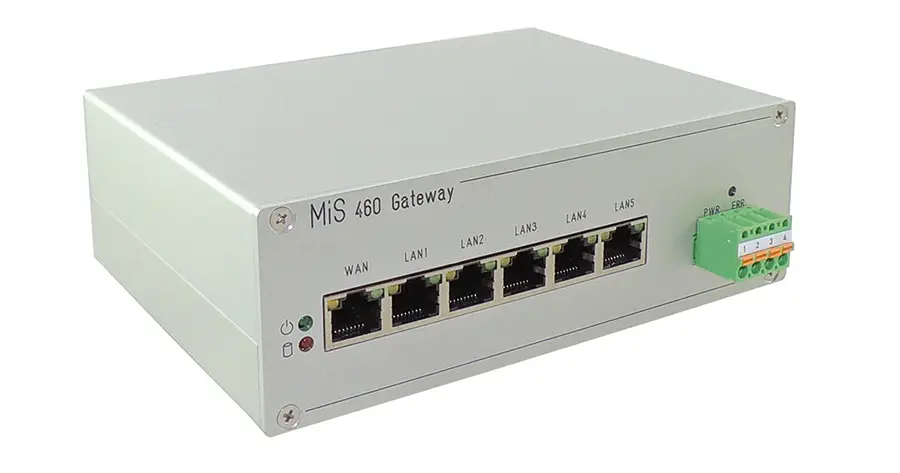
VEINLAND 460 Gateway – Controlled Transitions Between Networks
The VEINLAND 460 Gateway forms the defined boundary between trusted and untrusted networks on board.
Function within the overall system:
- Separation of internal onboard networks from external networks
- Controlled, time-limited connections
- Central enforcement of communication rules
Contribution to maritime cybersecurity:
- Protection against uncontrolled data traffic
- Secure remote maintenance
- Complete traceability of all connections The gateway is not a permanent pass-through, but a deliberately controlled security instrument.
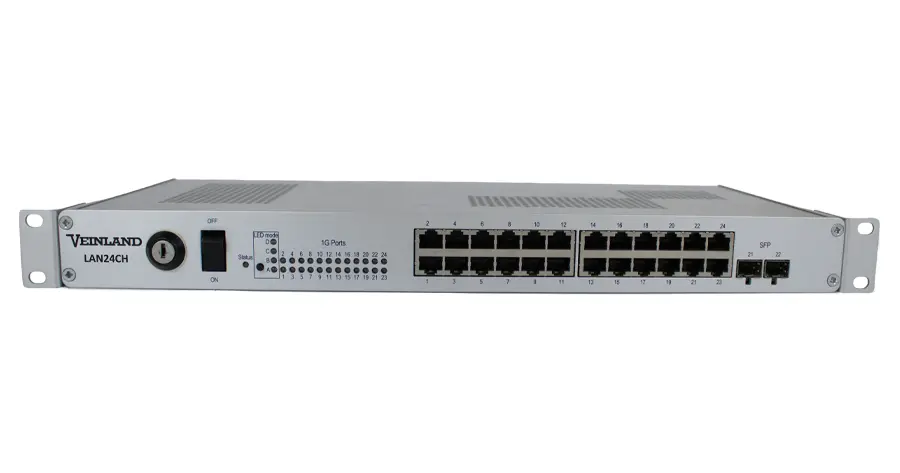
VEINLAND Ethernet Switch (IEC 61162-460 compliant)
The VEINLAND Ethernet Switch forms the structural basis of secure onboard networks.
Role in the security concept:
- Segmentation of safety-critical systems
- Stable, deterministic network structure
- Foundation for zone concepts
Contribution to cybersecurity:
- Limitation of lateral movement
- Clear system assignment
- Auditable infrastructure
The switch is not an isolated security product, but part of a holistic architecture.
Contact us for more information on integrating VEINLAND components into your maritime system architecture.
Standards & Compliance in Maritime Cybersecurity
The requirements for cybersecurity in the maritime industry are increasingly shaped by international regulations and technical standards. For shipping companies, shipyards, and system integrators, this means that cyber risks must be managed not only technically, but also organizationally and in a manner that can be documented. VEINLAND consciously aligns itself with this normative framework and supports its implementation on the technical level.
IMO MSC.428(98)
With Resolution MSC.428(98), the International Maritime Organization (IMO) requires operators to systematically integrate cyber risks into the Safety Management System (SMS). Cybersecurity is thereby explicitly understood as part of a ship’s operational safety.
The responsibility for implementation lies with the shipping company. The regulation does not demand a specific product, but rather a traceable, auditable approach to handling cyber risks, embedded into existing safety and operational processes.
VEINLAND supports this approach with a technical system architecture that makes cyber risks addressable in a structured way. Clear network structures, controlled transitions, and transparent system states form the basis for a practical implementation of the IMO requirements in day-to-day operations.
IEC 61162-460 (Edition 3)
The IEC 61162-460 standard is the central technical standard for secure maritime onboard networks. It describes how IP-based communication networks on board must be structured, separated into zones, and monitored to effectively limit cyber risks.
Core requirements include:
- Segregation of network zones
- Use of gateways as controlled transition points between trusted and untrusted networks
- Monitoring of network status, including alerting on any deviations
In addition, requirements are defined for secure configuration, maintenance, and access control.
VEINLAND’s products are specifically designed to meet these requirements and are type-approved. They support a standards-compliant, auditable, and future-proof network architecture on board.
IEC 62443 – OT Security as a Reference Framework
The international standard IEC 62443 was developed for industrial control and automation systems and serves as an established reference framework for OT security. In the maritime industry, it is gaining importance, particularly as a benchmark for the security of complex technical systems.
Key concepts include dividing systems into zones, defining controlled communication paths (conduits), and implementing a multi-layered security concept according to the “defense in depth” principle. These principles can be applied to maritime system landscapes in a sensible way, without introducing the full complexity of industrial IT security models.
VEINLAND adheres to these principles and implements them pragmatically in maritime system architecture – with the goal of harmonizing security, operational reliability, and technical manageability.
Standards-Compliant Implementation with VEINLAND Components
Implementing regulatory and normative requirements requires a technical infrastructure designed from the outset for security, separation, and controllability. VEINLAND’s network components are developed for use in safety-critical maritime environments and meet the relevant requirements of international standards.
Both the VEINLAND LAN24CH Switch and the VEINLAND 460 Gateway are certified and type-approved according to IEC 61162-460. They support the standards-compliant separation of network zones, controlled data exchange over defined transition points, and the monitoring of security-relevant network conditions.
In this way, VEINLAND products provide the technical foundation to address cybersecurity requirements not just on paper, but to implement them during everyday ship operations in a traceable, auditable, and future-proof manner.
IACS UR E26 / E27 and the Role of IEC 61162-460
As of July 1, 2024, the IACS Unified Requirements E26 and E27 impose binding cybersecurity requirements for Computer-Based Systems (CBS) on newbuilds. The goal of these regulations is to systematically address cyber risks across all relevant computer-based systems on board.
The scope also includes Operational Technology (OT) systems such as navigation and communication systems, as well as all IP-based interfaces between these systems – regardless of whether connections are permanent or temporary. The requirements apply to network devices, security components, computers, automation devices, and virtualized systems, among others.
The IEC 61162-460 standard primarily covers the navigation and communication domain and provides an established technical standard for secure maritime networks. For certain types of equipment, such as network and security components, IEC 61162-460 (Edition 3) can be recognized by classification societies as an equivalent technical basis for meeting the IACS UR E26/E27 requirements, provided these components are used within IEC 61162-460-compliant navigation networks.
VEINLAND offers a variety of products for the maritime industry, including network and security components with IP-based interfaces. These products are (or will be) type-approved as 460-Gateway, 460-Switch, 460-Node, 460-Forwarder, or 460-Network Monitoring Device in accordance with IEC 61162-460, and can thus be accepted by classification societies for use in navigation networks.
In addition, VEINLAND supports its customers by providing comprehensive documentation such as asset lists, network topologies, and detailed installation guides. This makes it easier to integrate the components into overarching systems and helps system integrators, shipyards, and classification societies meet the IACS UR E26/E27 requirements in a transparent, traceable way.
Cybersecurity in the maritime industry is not a product promise, but a matter of system architecture, responsibility, and control.
For technical inquiries or further information, please use our contact form.